- Scientific Team
- ZWF - Mission Statement
- Artistic Research at the MUK
- Annual theme
- ZWF events
- Current news
- Research projects
- Scientific Research Projects
- Overview Scientific Research Projects
- Beethoven
- The Austro-German Melodrama and its Film Music
- The Impact of Sound on the Screenplay, 1927—1934
- Deutschsprachige und anglophone Formenlehre der Nachkriegszeit
- The woman of my dreams
- ELEMU and the art of interaction
- European Landscapes
- Experiment Notation
- Film score for conveying ideology
- Flat, toxic, … , pornographic? Towards a complex techno-ecology of AI-generated gender images
- Gustav Mahlers Compositional Logic
- MUK History - Contemporary History
- Hellerau-Laxenburg
- Interdisziplinäre Mittelalterstudien
- It’s a Match!
- Cultural participation
- LSBTIQ* Bewegungen und Demokratie: Geschichte, Gegenwart und Zukunft
- MUK meets IFK
- Salon Différance
- Research on Dance Archives
- Theatre & Consciousness
- Urban Music Studies
- Hidden Paintings
- From Text to Performance: Literary Em-bodiment
- Wachau Myth
- Artistic Research Projects
- Overview Artistic Research Projects
- Archive of search
- Cabaret of Old News
- Composer/Performer Relations
- Cross-Genre Composition
- DANCR - an AI tool for dance research
- The vanishing of the archive
- The Art of Inclusion
- Dynamics of condensed systems
- Elementary Music Theatre
- Experiment Empathy in collaborative Improvisation
- Fiction and Research
- Franz Schubert — Der Akt des Dichtens in seiner musikalischen Darstellung
- FRAUEN*.FESTSPIELE.SALZBURG
- Gender and violence
- Inter-university research network Elfriede Jelinek
- Iterative Feedback Model for Collaborative Composition (IFMCC)
- Art and politics
- The correlation between the gaze, the voice,...
- Microtonality in Jazz
- Notation and performance
- Language and violence
- Suite Mixtur
- Transforming Instrumental Gestures
- WELT.AUTORIN.JELINEK
- Science – Art – Democracy
- Word.Music.Theatre
- Arts-based research (EEK)
- Overview EEK
- Artist in Residence Programm
- Artistic Research
- Moving images of Jewish culture / film and exile
- Carte blanche
- Didactics of Contempary Music and Composing
- Entente Musicale
- IGP and Community Music
- Jazz und seine Einflüsse aus anderen Musiktraditionen
- JETZT! – Inclusive Stage Practice as Artistic Research
- Method of Vienna
- Thinking music
- Operetta
- Poème électronique
- City and sound
- Viennese Original Sources
- vienna.composers@MUK
- Zeitgenössische klassische Musik & Jazz
- Scientific Research Projects
- Gender & Diversity
- Research Service
- Competence Centre Film | Film Music
- Joint Research Network E. Jelinek
- Teaching
Flat, toxic, … , pornographic? Towards a complex techno-ecology of AI-generated gender images
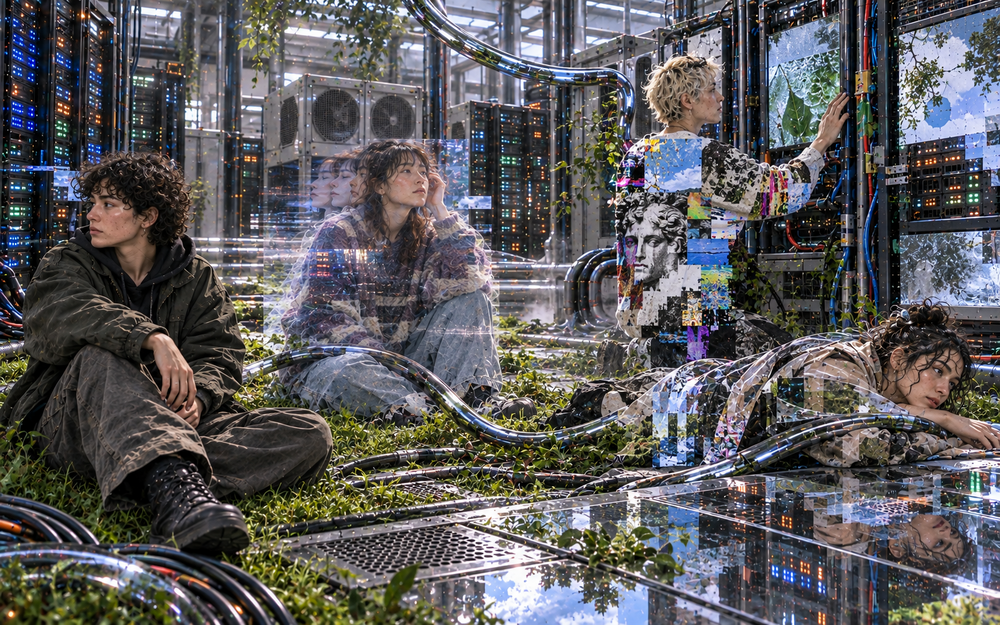
Since AI image generators became widely accessible to the public, millions of AI-generated images have been produced, circulated, and consumed every day. Their problematic effects – ranging from stereotypical representations of marginalized bodies and non-consensual fake pornography to the resurgence of nostalgic gender imaginaries – have become the subject of intense public and academic debate.
Against this backdrop, the four-year research project, Flat, Toxic, …, Pornographic? Towards a Complex Techno-Ecology of AI-Generated Gender Images, launched on 1 August 2026. Funded by the Austrian Science Fund (FWF) with €440,382, the project is led by Gender Studies scholar Prof. Dr. Ute Kalender and media philosopher Dr. phil. Aljoscha Weskott, together with a student research assistant (N.N.).
The project aims to epistemically refine current debates on AI-generated gender images by attending to a double movement. On the one hand, AI-generated images do re-naturalize and reactivate existing – and often nostalgic – gender orders. On the other hand, the project approaches AI-generated images as instruments of speculation through which gender, bodies, and their political orders can be imagined otherwise.
This speculative potential, however, is not understood in terms of transhumanist fantasies of progress, transcendence, or overcoming. Instead, the project focuses on the ambivalences, shifts, ruptures, and openings that emerge within contemporary visual techno-ecologies – and on how these might make other forms of gender politics thinkable.
Methodologically, the project works with Situational Analysis (Friese; Marres), a visually, speculatively, and topologically oriented analytical approach that is extended through techno-ecological perspectives (Preciado).
The project’s findings will be published in international academic journals, public-facing publications, and an English-language monograph. They will also inform innovative teaching and workshop formats that bring research on AI-generated imagery into dialogue with broader academic and public debates.
The project is supported by an international academic advisory board comprising Prof. Dr. Ashley Shew, Prof. Dr. Kara Keeling, and Prof. Dr. Louis Chude-Sokei.
More information is available here: https://www.fwf.ac.at/forschungsradar/10.55776/PAT3553825
A dedicated project account will also be launched soon, providing a space to discuss and contextualize emerging visual phenomena from a gender perspective.